Understanding the Symptoms and Causes of Psoriasis: Key Types and Treatments
2026.08.27
Psoriasis is a major chronic immune-mediated inflammatory disease that significantly affects patients’ quality of life as its symptoms repeatedly worsen and improve. Although it mainly manifests as skin lesions, it can affect other parts of the body, including the joints. It should therefore be understood as a systemic disease, not merely a skin condition.
Given the variable course of the disease, a personalized treatment strategy is established for each patient by comprehensively considering the extent of lesion involvement, severity, clinical presentation, quality of life, and comorbidities. Recently, treatment efficacy has further improved with biologics that target the molecules responsible for inflammation, while the wider availability of biosimilars has also significantly improved access to treatment.
Today, we will focus on psoriasis affecting the skin, the most common form of the disease, beginning with its key symptoms and then exploring how biosimilars have changed the treatment landscape.
| Causes of Psoriasis: A Chronic, Relapsing Immune Disease
While the underlying cause of psoriasis has not yet been clearly identified, the disease is believed to develop in genetically susceptible individuals following exposure to external stimuli.
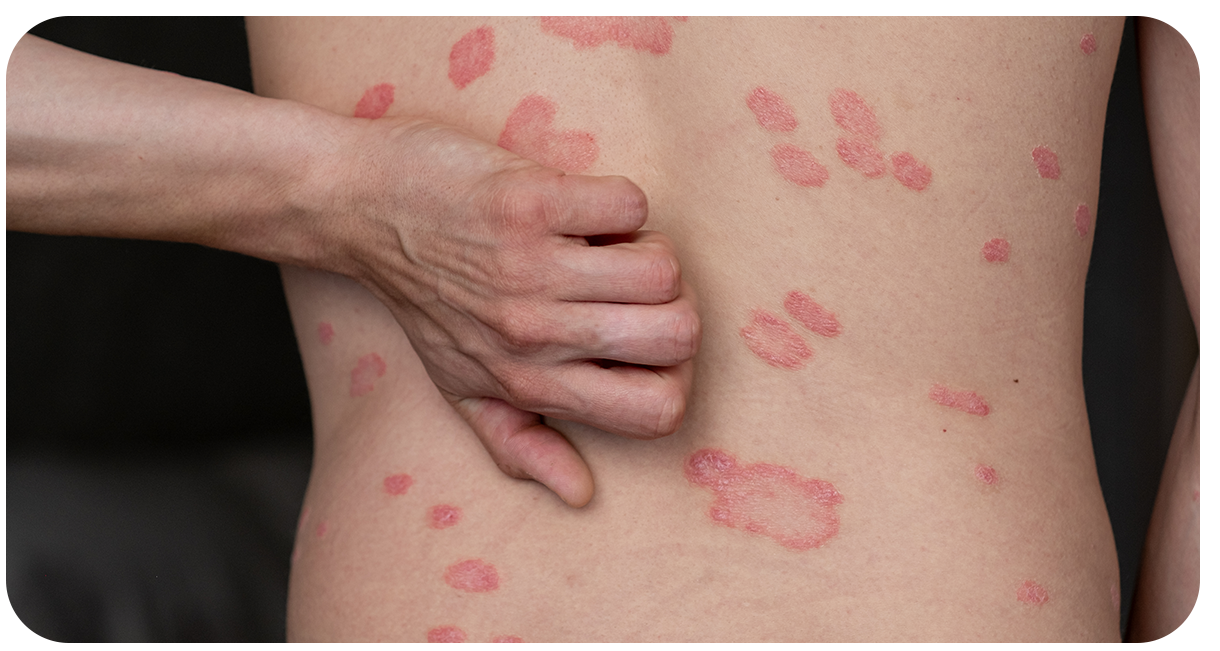
When immune cells such as T cells are excessively activated by environmental factors such as trauma or infection, inflammatory substances such as cytokines and chemokines are secreted. This induces the following skin changes:
- Excessive proliferation and abnormal differentiation of skin cells
- An increase in microvessels
- Infiltration of inflammatory cells into skin tissue
If this immune-inflammatory response does not remain confined to the skin and extends to the joints, it causes psoriatic arthritis. Furthermore, if it affects insulin secretion or lipid metabolism, it can lead to various metabolic comorbidities.
| Clinical Presentation and Classification of Psoriasis
While normal skin cell regeneration takes about 28 days, this process occurs in just 3 to 5 days in patients with psoriasis due to a hyperactive immune response. As a result, dead skin cells that have not yet been shed build up in layers, forming red spots (papules) covered with silvery-white scales.
Psoriasis affecting the skin can be classified as follows according to its morphology and clinical presentation:
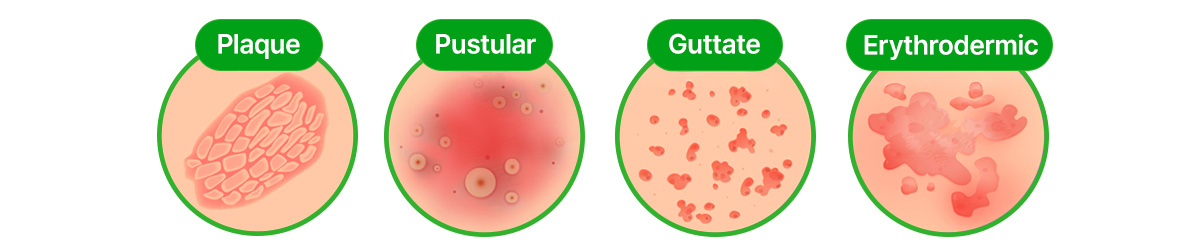
Plaque Psoriasis
This is the most common type, accounting for 80–90% of all psoriasis cases. It typically occurs symmetrically in areas frequently exposed to external irritation, such as the elbows, knees, buttocks, and scalp.
Guttate Psoriasis
This type develops acutely following an upper respiratory tract infection, such as tonsillitis, caused by group A β-hemolytic streptococci. It manifests as droplet-shaped lesions measuring 0.5–1.5 cm that are widely scattered throughout the body.
Pustular Psoriasis
This is an acute and severe type characterized by sterile pustules appearing either locally on the palms and soles or throughout the body. Generalized pustular psoriasis is accompanied by a systemic inflammatory response, including fever and leukocytosis, and therefore requires urgent inpatient treatment.
Erythrodermic (Exfoliative) Psoriasis
This is the most severe type, featuring widespread erythema and exfoliation affecting more than 90% of the body surface area. Loss of the skin’s thermoregulatory and barrier functions can lead to life-threatening complications, including infection, fluid imbalance, and heart failure.
| Key Symptoms and Diagnostic Methods of Psoriasis
While normal skin cell regeneration takes about 28 days, this process occurs in just 3 to 5 days in patients with psoriasis due to a hyperactive immune response. As a result, dead skin cells that have not yet been shed build up in layers, forming red spots (papules) covered with silvery-white scales.
1. Symptoms of Psoriasis

In the early stage of psoriasis, small pink spots appear and gradually enlarge and coalesce, becoming clearly demarcated from the surrounding skin. Thick, silvery-white scales then form over the lesions, which commonly develop in areas exposed to frequent friction, such as the knees, elbows, buttocks, and scalp. During acute phases, when symptoms worsen, pus-filled lesions (pustules) may form throughout the body.
2. Diagnosis of Psoriasis
The diagnosis of psoriasis is initially based on a visual clinical examination of the morphology and characteristics of skin lesions. When necessary, a biopsy is performed to differentiate psoriasis from other skin conditions. The biopsy is evaluated for findings such as epidermal hyperkeratosis, parakeratosis, and dermal inflammatory cell infiltration.
Disease severity is then assessed based on Body Surface Area (BSA), which indicates the extent of the lesions, and the Psoriasis Area and Severity Index (PASI) score, which provides a comprehensive assessment of severity. The most appropriate treatment plan is then established for each patient.
| Classification | Evaluation Criteria | Treatment Strategy |
Mild | BSA < 5% or PASI < 5 | Topical monotherapy |
Moderate | BSA 5–10% or PASI 5–10 | Topical therapy plus phototherapy or systemic agents |
Severe | BSA > 10% or PASI > 10 | Consider biologics |
| Psoriasis Treatment Options by Disease Severity
Psoriasis treatments are broadly categorized into topical therapy, systemic therapy, phototherapy, and biologics.
1. Mild Psoriasis: Topical Therapy
In the early stages, when symptoms are relatively mild, topical therapy involves applying medication directly to affected areas. Corticosteroids, vitamin D3 derivatives, and moisturizers are used to reduce inflammation.
2. Moderate-to-Severe Psoriasis: Systemic Therapy and Phototherapy
When symptoms are widespread or severe, oral systemic agents such as immunosuppressants (methotrexate, cyclosporine) or retinoids are administered. However, long-term administration requires regular blood tests, as it may strain the liver or kidneys or induce hypertension. In addition, phototherapy using ultraviolet light may be administered concurrently. Narrowband UVB (NB-UVB) therapy, whose safety and efficacy have been established, is now the most commonly used approach.
3. Refractory and Severe Psoriasis: Biologics
For patients with severe psoriasis who do not respond to conventional systemic agents or phototherapy, or who cannot continue treatment because of side effects, biologics that selectively block specific inflammatory mediators are administered. One representative biologic is ustekinumab.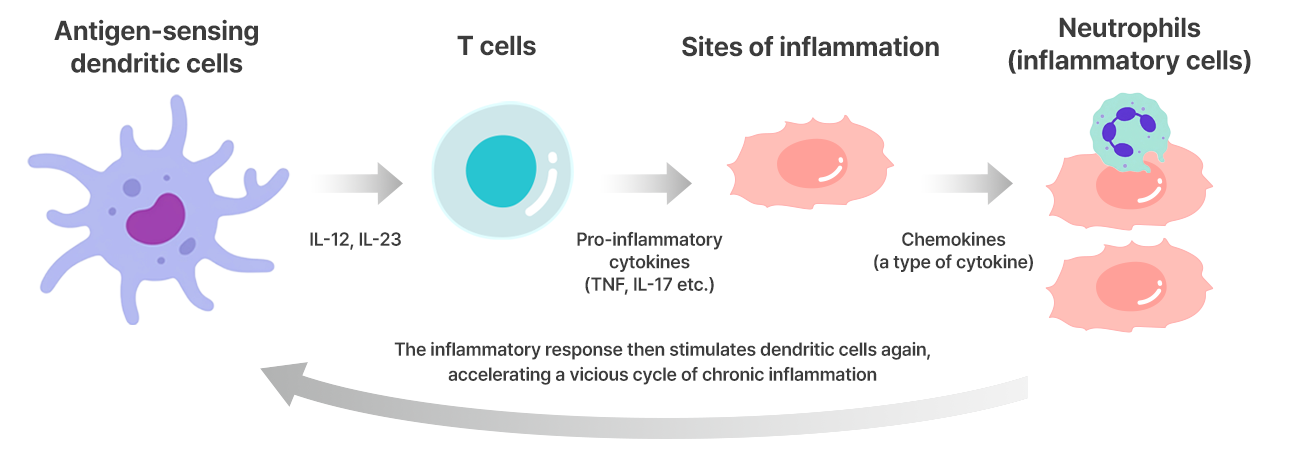
Interleukin-12 (IL-12) and interleukin-23 (IL-23), secreted by antigen-sensing dendritic cells, activate T cells at an early stage of the immune response, triggering psoriatic inflammation. Ustekinumab is a monoclonal antibody that selectively inhibits IL-12 and IL-23, thereby blocking inflammatory signaling at an early stage.
Through this preemptive blockade, the release by activated T cells of inflammatory cytokines, such as tumor necrosis factor (TNF) and interleukin-17 (IL-17), and chemokines is also inhibited. Consequently, this prevents neutrophils (inflammatory cells) from infiltrating sites of inflammation, such as the skin and joints, effectively suppressing chronic inflammation.
| Expanding the Treatment Paradigm Through Biosimilars
Since psoriasis is a chronic skin disease requiring consistent long-term management, sustainable treatment options and reduced financial burden are crucial for patients. The introduction of biologics has significantly increased PASI 90 response rates (at least a 90% improvement in the PASI score from baseline) among patients with severe psoriasis; however, high drug costs remained a formidable barrier.
Celltrion consistently develops and supplies biosimilars for autoimmune diseases, including ustekinumab biosimilars. The wider availability of these biosimilars provides a cost-effective alternative for patients burdened by expensive treatments, contributing to reduced healthcare spending worldwide and improved access to treatment.
Because psoriasis arises from immune system dysregulation, identifying the precise cause and implementing personalized treatment according to disease severity are paramount. With advances in biologics, patients with severe psoriasis, for whom treatment options were clearly limited in the past, can now achieve substantial improvement in their lesions and resume their daily lives.
If you are experiencing a reduced quality of life due to skin lesions, it is advisable to consult with medical professionals and develop a treatment plan tailored to your needs. Celltrion will continue to improve access to treatment for patients with psoriasis worldwide through ongoing biopharmaceutical research and development, striving to create an environment in which they can lead healthier lives.